English

0 item(s)
View cart
You have no items in your shopping cart.
Commercial Display Refrigerator Buying Guide for Restaurants, Grocery Stores, Convenience Stores, Cafés, and Retail Businesses
A commercial display refrigerator does much more than keep food and beverages cold. In a busy retail or foodservice environment, it also plays an important role in product presentation, customer convenience, space utilization, and daily operating efficiency.
Unlike traditional solid-door commercial refrigerators that are primarily designed for storage, display refrigerators allow customers to see products before opening the door. This makes beverages, dairy products, desserts, prepared foods, and other grab-and-go items easier to browse and more attractive to shoppers.
However, not every business needs the same type of display refrigerator. The ideal unit depends on what you sell, how much space you have, how frequently customers access the products, and how you want your products to be presented.
In this guide, we'll explain the most important factors to consider when choosing a commercial display refrigerator and help you find the right configuration for your business.
Product visibility can have a major impact on the customer shopping experience.
A well-organized glass door refrigerator allows customers to quickly see available products without repeatedly opening the door. Internal lighting can make products easier to identify, while adjustable shelving allows businesses to organize different product sizes and categories efficiently.
For businesses selling beverages, packaged foods, desserts, dairy products, or ready-to-eat meals, a display refrigerator can serve two purposes at the same time:
Keep products properly refrigerated
Put products directly in front of customers
This combination makes commercial display refrigeration particularly useful in high-traffic environments where convenience and product visibility are important.
Glass door merchandiser refrigerators are one of the most versatile choices for commercial retail environments.
They are commonly used to display bottled drinks, canned beverages, dairy products, packaged foods, desserts, and grab-and-go items. Because customers can see the products through the glass doors, they can quickly find what they want without opening multiple doors.
Single-door models are ideal for smaller businesses or locations with limited floor space. Two-door and multi-door models provide greater storage capacity and allow businesses to display a wider product selection.
Convenience stores
Grocery stores
Restaurants
Cafés
Gas stations
Retail stores
Grab-and-go food areas
When choosing a glass door merchandiser, consider door configuration, interior capacity, shelf adjustability, lighting, temperature performance, and available floor space.

If space is limited, a single-door commercial display refrigerator can provide an efficient balance between storage and product visibility.
These compact units are particularly useful for cafés, small restaurants, bakeries, convenience stores, and retail counters.
A single-door design can also be used as an additional refrigeration unit when your existing refrigerator does not provide enough display space.
Because of their smaller footprint, these refrigerators can often be positioned close to checkout areas or other high-traffic locations where customers can easily see the products.
Small retail stores
Coffee shops
Bakeries
Small restaurants
Beverage stations
Limited-space location

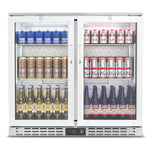
Businesses with higher product volume may benefit from a larger two-door or multi-door display refrigerator.
These units provide significantly more display space while keeping products organized across multiple shelves. Multiple doors also make it easier for customers to browse different product categories.
For example, one section can be used for bottled beverages, another for canned drinks, and another for dairy or packaged foods.
Multi-door refrigerators are particularly useful in larger retail environments where product variety and customer traffic are high.
Supermarkets
Large convenience stores
Grocery stores
Restaurants
Foodservice businesses
High-volume retail locations
When selecting a larger unit, make sure to measure not only the available floor space but also doorways, hallways, elevators, and installation areas.
One of the most important decisions is whether your business needs a glass door refrigerator or an open-air display refrigerator.
Glass door models create a physical barrier between the refrigerated interior and the surrounding environment. This helps reduce cold-air loss while still providing excellent product visibility.
Open display refrigerators, on the other hand, allow customers to grab products immediately without opening a door. This can be useful in high-traffic grab-and-go environments.
However, open-air designs generally require more careful temperature management because the refrigerated space is continuously exposed to ambient air.
Advantages:
Excellent product visibility
Better separation from ambient air
Convenient product organization
Suitable for beverages and packaged foods
Good choice for long-term product display
Advantages:
Extremely convenient access
Ideal for grab-and-go products
Fast customer interaction
Suitable for high-turnover products
The right choice depends on your product type, store layout, customer traffic, and merchandising strategy.
The orientation of a display refrigerator also affects how efficiently you can use your commercial space.
Vertical refrigerators use height to maximize refrigerated storage while maintaining a relatively small floor footprint.
They are especially useful when floor space is limited but businesses still need substantial display capacity.
Vertical units are commonly used for:
Beverages
Dairy products
Packaged foods
Desserts
Grab-and-go products
Horizontal display cases provide a wider product presentation area and can make it easier for customers to view products from above or from the front.
They are often used for specialty food displays, deli products, desserts, and promotional merchandise.
The best orientation depends on your available space and how customers move through your store.

Businesses selling fresh food often require a different type of display refrigeration.
Deli display cases, bakery cases, and specialty refrigerated showcases are designed to present products while helping maintain appropriate refrigerated conditions.
These units are commonly used for:
Fresh meats
Cheese
Prepared foods
Cakes and desserts
Sandwiches
Salads
Specialty foods
For these applications, product presentation is especially important because customers often make purchasing decisions based on appearance.
A clean glass front, bright interior lighting, organized shelves, and consistent cooling can all contribute to a better presentation.

Cooling performance is one of the most important considerations when purchasing commercial refrigeration equipment.
A reliable refrigeration system should maintain consistent temperatures while operating efficiently throughout the day.
When comparing different models, pay attention to:
Compressor performance
Airflow design
Insulation
Temperature control
Automatic defrost
Door sealing
Refrigerant type
Interior airflow distribution
Fan-assisted or forced-air cooling can help distribute cold air more evenly throughout the cabinet, which is especially important for refrigerators with multiple shelves.
A well-designed airflow system can help reduce temperature variation between different areas of the cabinet and maintain more consistent refrigeration performance.

Commercial refrigerators often operate continuously, so energy consumption can have a meaningful impact on long-term operating costs.
Several design features can contribute to improved efficiency, including:
LED interior lighting
High-quality insulation
Efficient compressors
Well-sealed doors
Energy-efficient fans
Automatic temperature controls
Properly designed refrigeration systems
Glass door refrigerators can also help businesses display products without requiring customers to open the cabinet repeatedly.
For high-volume businesses, even small improvements in operating efficiency can become significant over time.
A commercial display refrigerator should not simply provide cold storage. It should help customers find and notice your products.
Consider how your products will look inside the refrigerator.
Adjustable shelves allow you to accommodate different bottle, can, container, and package sizes. Interior LED lighting can improve visibility and make the cabinet look brighter and more organized.
For best results, organize products by category and keep popular products at eye level.
A well-stocked and organized refrigerator can create a cleaner shopping experience and make it easier for customers to make purchasing decisions.
The best commercial display refrigerator depends heavily on your business type.
| Business Type | Recommended Display Refrigerator |
|---|---|
| Convenience Store | Vertical glass door merchandiser |
| Grocery Store | Multi-door merchandiser or open display case |
| Café | Single-door or countertop display refrigerator |
| Bakery | Refrigerated bakery display case |
| Restaurant | Glass door merchandiser or specialty display case |
| Deli | Refrigerated deli display case |
| Gas Station | Vertical beverage merchandiser |
| Supermarket | Multi-door display refrigerators and freezers |
Instead of choosing the largest refrigerator available, select a model that matches your product volume, available space, and customer traffic.
Before ordering a commercial display refrigerator, always measure the installation area carefully.
Check:
Available width
Available depth
Available height
Doorway dimensions
Hallway clearance
Electrical outlet location
Ventilation clearance
Customer walking space
Remember that the refrigerator must not only fit into the final location—it also needs to be transported there.
For larger commercial refrigerators, checking the delivery route in advance can help prevent installation problems.
Choosing commercial refrigeration based only on price can create problems later.
Some common mistakes include:
A refrigerator that is constantly overcrowded can make products difficult to organize and may restrict proper airflow.
Oversized equipment takes up valuable floor space and may not provide meaningful benefits if product turnover is low.
A refrigerator placed in an inconvenient location may provide excellent storage but poor merchandising results.
Swing doors require enough clearance to open safely without blocking walkways or nearby equipment.
A modern-looking refrigerator is useful only if it also provides reliable temperature control, efficient refrigeration, and practical storage.
Choosing a commercial display refrigerator is about more than selecting a cabinet that keeps products cold.
The right refrigerator should fit your space, match your products, support your customer flow, and provide reliable refrigeration day after day.
Glass door merchandisers are an excellent choice for beverages and packaged foods. Larger multi-door units can provide greater capacity for high-volume businesses, while compact countertop and single-door models work well in cafés, bakeries, and smaller stores. For fresh foods, specialized deli and bakery display cases can provide better product presentation.
Before making a purchase, consider your product category, available space, customer traffic, storage capacity, cooling performance, energy efficiency, and overall merchandising strategy.
When the right refrigeration equipment is matched with the right business environment, a commercial display refrigerator can do more than preserve products—it can help create a cleaner, more attractive, and more convenient shopping experience.